-
- EN
-

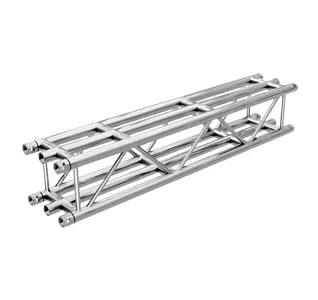
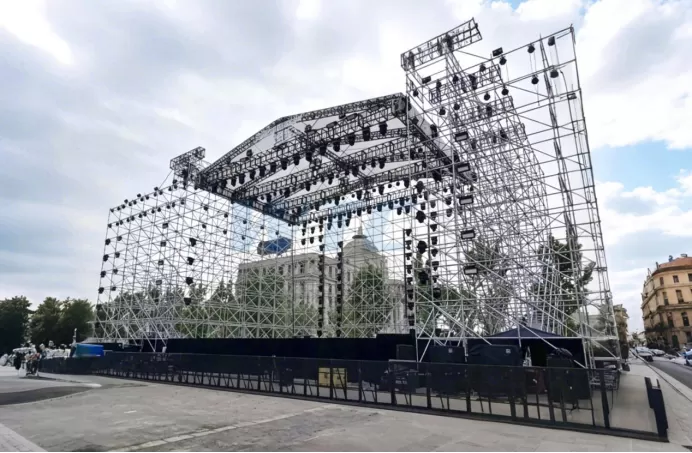
Aluminum stage truss belongs to the temporary load-bearing structural system. Its material performance, structural stress conditions and installation technology directly affect event safety and operational reliability. Performance, exhibition and commercial events feature complex site conditions and tight construction schedules, which require strict compliance with national codes and industry standards.
Formulated in accordance with GB/T 36731-2018/XG1-2022 Safety of Stages and Grandstands for Temporarily Built Performance Venues, GB 50429-2007 Code for Design of Aluminum Alloy Structures, WH/T 78.6-2017 Performance Safety — Part 6: Stage Art Installation Safety and other relevant standards, this guide integrates the core erection procedures from the perspectives of material metallurgy, structural mechanics, foundation engineering and performance safety, balancing construction safety and on-site implementation efficiency.
Aluminum alloy truss materials must comply with national standard requirements. The performance of aluminum alloy tubes for stage trusses shall not be lower than 6082-T6 specified in GB/T 3190-2008, with a Webster hardness above 16°; section profiles shall not be lower than 6061-T5 aluminum alloy, with a Webster hardness above 14°. Mechanical properties and wall thickness deviation shall meet the requirements of Chapter 3 in GB/T 6892-2015 Aluminum and Aluminum Alloy Extruded Profiles and GB 50429-2007 Code for Design of Aluminum Alloy Structures.
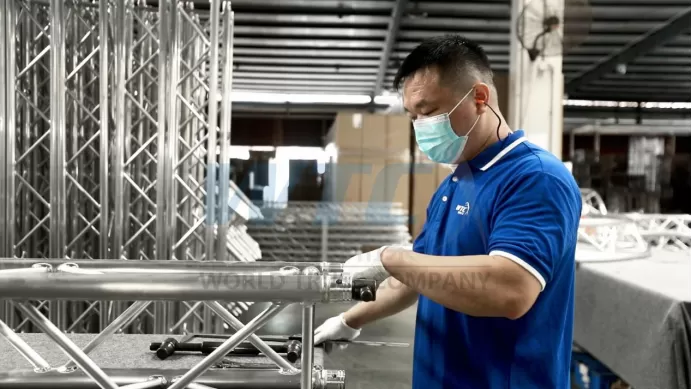
*Product inspection
Full inspection of each component is mandatory before installation:
Profile surface finish complies with GB/T 14846, free of cracks, deformation and corrosion;
Deviation between actual wall thickness and design value ≤ ±5%; measured at 3 points over 100mm away from the pipe end using a micrometer with resolution ≤ 0.01mm;
Weld joints free of incomplete welding, missed welding, slag inclusion and air holes; visual inspection of welds implemented per GB/T 22086-2008;
Remarkable strength reduction exists in the Heat-Affected Zone (HAZ) of aluminum alloy welds; verify the Welding Procedure Qualification Report and conduct hardness re-test if necessary;
Install insulating gaskets or apply galvanic corrosion resistant coatings at contact points with dissimilar metals (e.g. steel connectors).
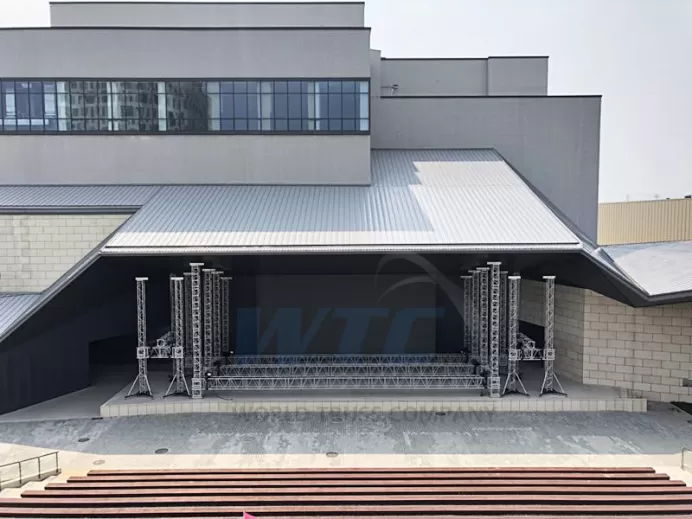
*Customized solutions tailored to application scenarios for the National Centre for the Performing Arts
Most erection accidents stem from insufficient assessment of ground conditions. The foundation of stage trusses shall conform to GB/T 36731-2018/XG1-2022, with targeted treatment for indoor and outdoor scenarios respectively.
Outdoor Venues: Lay square timber or steel plates to disperse stress on lawns, sandy land and uneven ground; the area of load-bearing base plates shall satisfy: Base Plate Area ≥ Truss Single Leg Axial Force ÷ (Characteristic Foundation Bearing Capacity × 0.8), with a minimum side length of 300mm minimum. Implement anti-slip, drainage (slope ≥ 2%) and anti-settlement measures. For long-span trusses (span >15m), conduct foundation preloading observation: sustain 1.0 times design load for 24 hours with total settlement ≤ L/1000 to avoid structural instability caused by uneven settlement.
Wind resistance design shall be adopted for outdoor erection; the basic wind pressure shall be taken per GB 50009, with consideration of maximum gust coefficient. The horizontal distance between stage facilities and overhead power lines of 10kV and above shall not be less than 1.5 times the vertical distance from the power line to the ground.
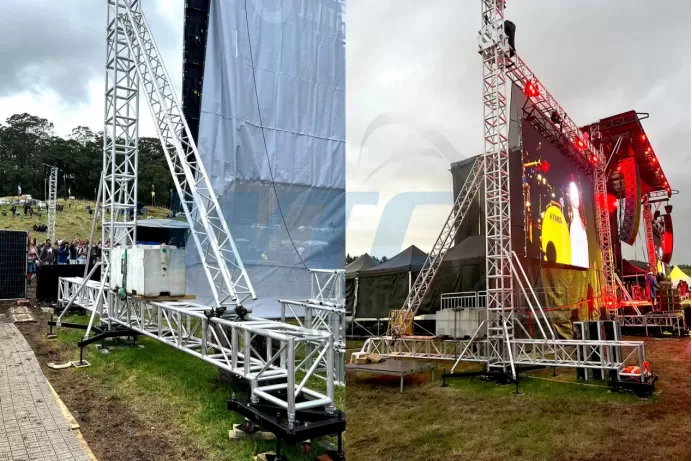
*On-site erection
The overall strength of the truss relies on dual protection of members and connection nodes. Aluminum stage trusses adopt pin-type or bolted connections; all member axes shall converge at one node to avoid eccentric stress.
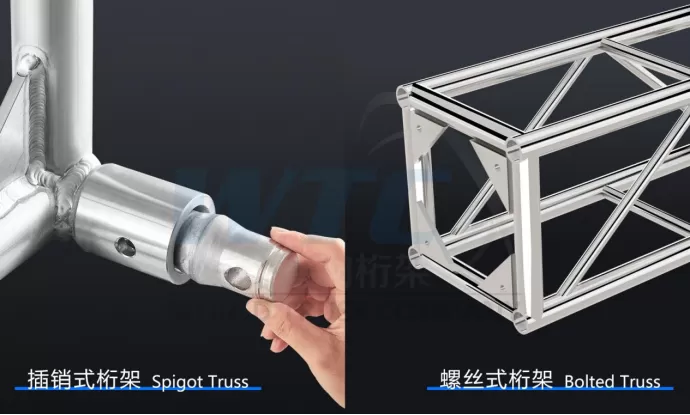
*Connection modes of spigot truss and bolt truss
Main load-bearing trusses are recommended for bolted connection with bolt performance grade no lower than Grade 8.8, with standard pre-tightening torque and double nuts or nylon lock nuts for anti-loosening. Quick-assembly lighting trusses can adopt pin connection; pins shall be made of Q345 grade steel with sufficient yield strength, fully inserted and locked by spring locking plates. Flexible connectors such as steel wire ropes and iron wires are strictly prohibited as structural load-bearing components.
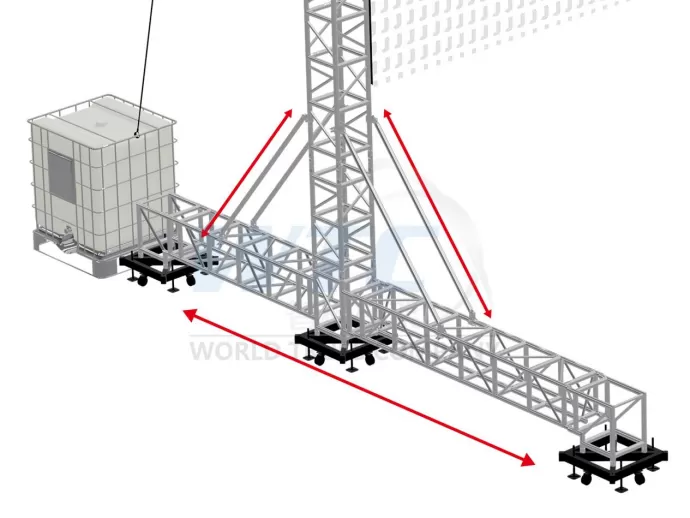
*Schematic diagram of horizontal bracing + diagonal bracing
Trusses must be equipped with lateral supports and diagonal supports (e.g. scissor bracing, cross tension rods) to form a geometrically invariant system, ensuring longitudinal and lateral stability and preventing lateral instability.
Inspect all splicing positions during construction: fully inserted pins, locked spring plates, standard bolt torque, no component misalignment, missing fittings or assembly gaps. Ensure connection rigidity meets stress requirements, and eliminate irregularities such as loose parts, splicing misalignment and omitted fittings.
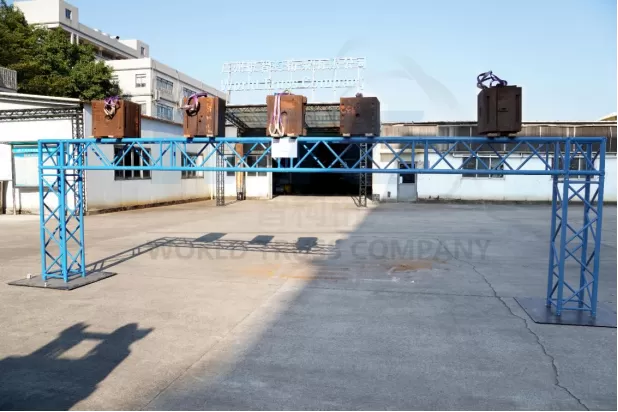
*WTC load-bearing test
Load bearing shall strictly follow design parameters. Calculate loads in accordance with GB/T 36731 and WH/T 78.6; for overseas projects, refer to industry practices of EN 17115 and ANSI E1.21. To cover strength loss in aluminum alloy welding heat-affected zones and micro-damage caused by frequent assembly and disassembly, the material yield strength reserve coefficient shall be set at 2.5-3.0 in static analysis.
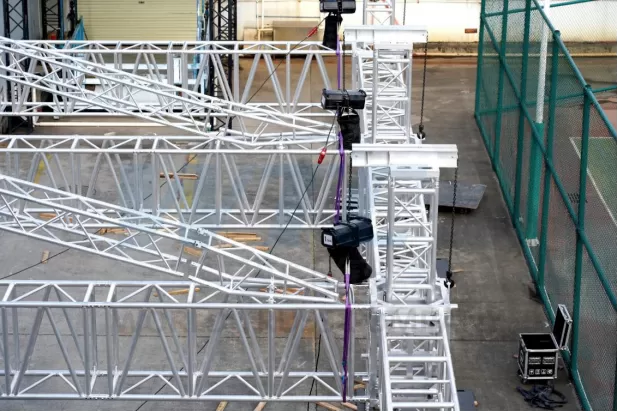
*Pre-delivery trial assembly test of WTC products
Impact/Dynamic Load: Apply a dynamic increase coefficient of 1.2 for dynamic systems such as electric hoists; adopt an impact coefficient of 1.3 under severe start-stop working conditions.
Wind Load: Outdoor erection complies with GB 50009 (minimum 0.35 kN/m²); specially verify shape coefficient and wind vibration impact for large windward equipment such as LED screens.
The overall safety factor under ultimate limit state ≥ 2.0 (permanent load partial factor 1.2, live/dynamic load partial factor 1.4). For large eccentric loads (e.g. suspended LED screens), overturning stability verification is mandatory with a safety factor ≥ 1.8, and reliable anti-slip measures shall be equipped for ballast weights.
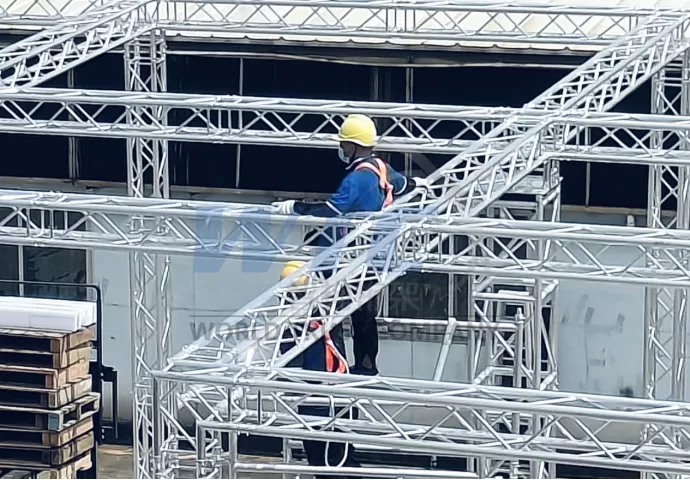
*Pre-delivery trial assembly test of WTC products
Equipment Safety Cable: Breaking tension ≥ 2 times equipment weight; the sag travel of safety cables shall be controlled within 15cm to reduce impact force.
Personnel Protection: Wear full-body safety harness complying with GB 6095, and attach to an independent lifeline system separated from the truss structure or specially designed for load bearing.
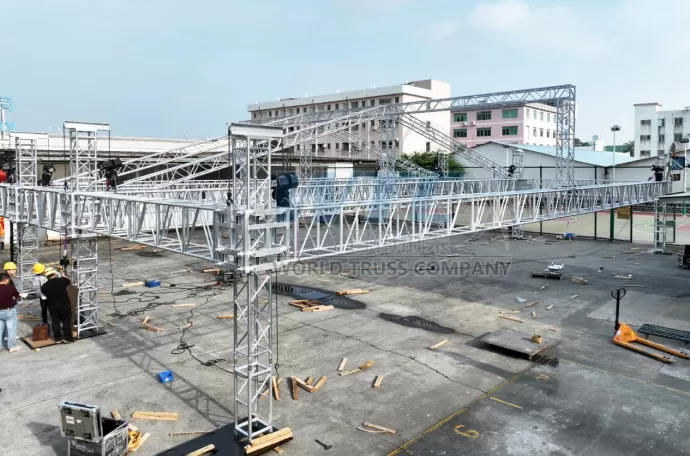
*Pre-delivery trial assembly test of WTC products
The erection of aluminum stage trusses is a systematic work integrating material mechanics, structural engineering and practical operation experience. Safety is paramount; standardized operation and detailed inspection in every procedure guarantee event safety and on-site effect.
Implement the three-inspection system of incoming acceptance, process inspection and final acceptance throughout construction. Overloading and arbitrary structural modification are strictly prohibited during service; dismantlement shall follow the reverse sequence of erection with sectional removal, and throwing components from height is forbidden. All relevant technical archives shall be retained for a minimum of 5 years.
As a professional manufacturer deeply engaged in the stage truss industry, WTC ensures traceability of every single member and record of every welding seam. Brilliant stage effects can be replicated, but safety allows no trial and error. No matter how gorgeous the stage is, safety is always the non-negotiable cornerstone.
[1] GB/T 36731-2018/XG1-2022, Safety of Stages and Grandstands for Temporarily Built Performance Venues [S]. Beijing: China Standards Press, 2018 (Including Amendment No.1 of 2022): Clause 5.4 Structural Safety Technical Requirements, Clause 5.5.2 Process Safety Technical Requirements – Structural Members.
[2] GB 50429-2007, Code for Design of Aluminum Alloy Structures [S]. Beijing: China Planning Press, 2007.
[3] WH/T 78.6-2017, Performance Safety — Part 6: Stage Art Installation Safety [S]. Beijing: China Standards Press, 2017: Clause 6.2 Load, Clause 6.3 Safety Factor.
[4] WH/T 92-2021, Code for Supervision and Inspection of Safety of Temporarily Built Stage and Grandstand for Performance Venues [S].
[5] GB 50009-2012, Load Code for the Design of Building Structures [S]. Beijing: China Architecture & Building Press, 2012.
[6] GB 6095-2021, Personal Fall Protection — Safety Harness [S]. Beijing: China Standards Press, 2021.
[7] GB/T 6892-2015, Aluminum and Aluminum Alloy Extruded Profiles [S].
[8] GB/T 22086-2008, Recommended Welding Procedure for Aluminum and Aluminum Alloy Arc Welding [S].
.jpg "Motorized Lifting Truss System Series 3(30 Tonne Heavy-Duty Electric Cylinder System)") Motorized Lifting Truss System Series 3(30 Tonne Heavy-Duty Electric Cylinder System)
Motorized Lifting Truss System Series 3(30 Tonne Heavy-Duty Electric Cylinder System)
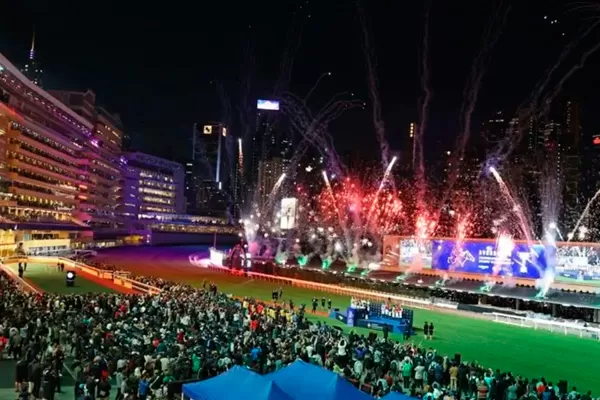 Ayrton Cobra Lit up 2022 Longines International Jockeys' Championship
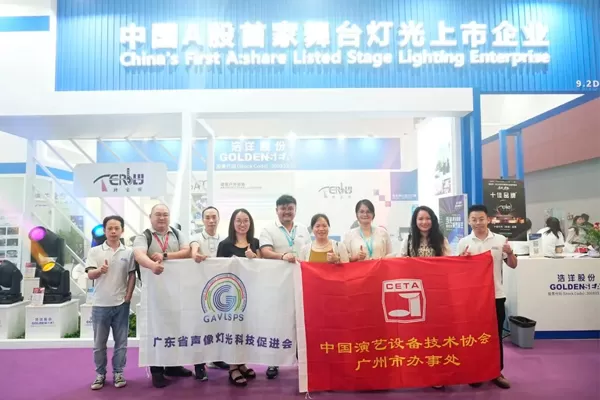 Golden Sea Successfully Finished Its Exhibition at PLSG 2024!
.png "Students from China Academy of Chinese Theatre Arts Visit WTC for Industrial Study") Students from China Academy of Chinese Theatre Arts Visit WTC for Industrial Study
Students from China Academy of Chinese Theatre Arts Visit WTC for Industrial Study
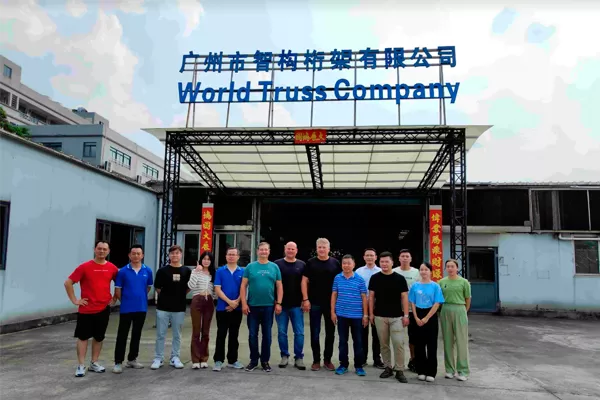 【WTC】Warmly Welcome the European Czech TAF Welding Experts to WTC to Guide the Work