-
- EN
-

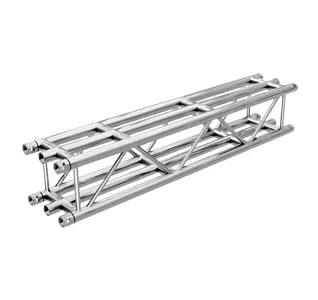
Load capacity is the number one safety issue in live events, touring, and fixed installations. A square truss may look simple, but its real capacity depends on engineering factors including span length, point-load locations, connection type, bracing, and allowable deflection. This guide explains how load-bearing capacity is determined in practical terms and what to request from square truss manufacturers to ensure safe, compliant builds.
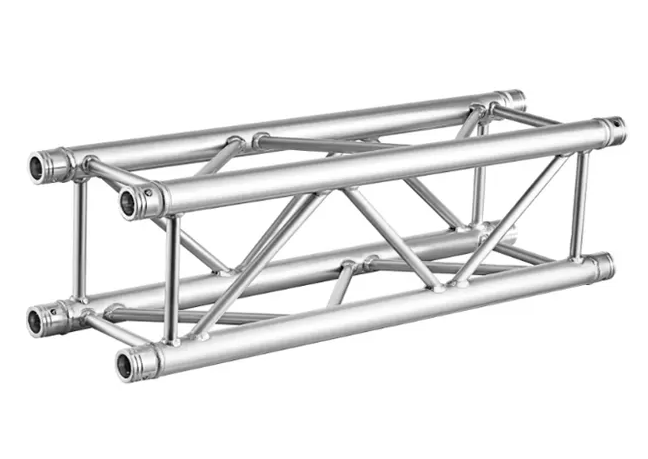
The load capacity figure printed in a truss catalog is a starting point, not an answer. The actual safe working load for your specific build depends on how the truss is configured, supported, and loaded — and these factors change significantly between applications.
| Capacity Variable | What Changes | Why It Matters |
|---|---|---|
| Span length | Capacity decreases as span increases — often non-linearly | A truss rated for 500 kg at 4 m span may only carry 180 kg at 8 m |
| Load type | Point load vs distributed load produce different stress profiles | A single hoist at mid-span is more demanding than the same weight spread evenly |
| Load position | Center-span load is worst case; quarter-span load is less severe | Load table values are typically for worst-case mid-span; off-center loads need separate calculation |
| Connection method | Spigot/pin joints have different stiffness than bolted connections | Connection compliance affects real-world stiffness and load distribution |
| Support conditions | Simply supported vs continuous over multiple supports changes the span behavior | Multi-span systems require different analysis than single-span runs |
Load tables specific to the truss series — not generic ratings that cover the whole product range
Separate data for point loads and distributed loads
Capacity data at multiple span lengths, not just one reference span
Clear statement of what safety factor is applied in the published load table
Understanding the engineering factors that change capacity from the catalog number to the real application number is essential for safe planning.
| Factor | Effect on Capacity | Practical Guidance |
|---|---|---|
| Longer spans | Bending moment increases with the square of span length — capacity drops significantly | Use load tables at the exact span you are building, not the nearest round number |
| Off-center point loads | Mid-span load produces maximum bending moment; loads at other positions produce lower but still significant moments | Calculate each load position separately; sum the combined effect |
| Cantilever extensions | A cantilever generates bending in the opposite direction to the mid-span — combined effects can be complex | Cantilever loads require engineer review; do not apply standard span tables |
| Dynamic loads | Moving audiences, wind, vibration from speakers all add to the static weight | Apply a dynamic load factor — typically 1.25–1.5× the static payload — to account for movement |
| Lateral and wind loads | Horizontal forces from wind or crowd push create lateral bending in the truss | Outdoor and temporary structures need explicit lateral load analysis |
Deflection is the mid-span sag of a loaded truss. Structural design standards typically limit deflection to span/250 or span/300 for display and equipment structures.
A 6 m span at span/250 limit deflects a maximum of 24 mm at mid-span
Beyond this limit, the truss is not necessarily about to fail — but the structure is overstressed relative to its design basis
For LED walls, excessive deflection is visible to the audience and causes panel misalignment
For rigging, deflection that exceeds limits changes the load path and can overload connection points
Design from the deflection limit, not just the strength limit — whichever is more restrictive governs the design.
| Construction Element | What to Compare | Why It Affects Strength |
|---|---|---|
| Main tube outer diameter | 50 mm vs 76 mm standard sizes | Larger tube provides significantly higher section modulus and bending resistance |
| Wall thickness | 2 mm vs 3 mm vs 4 mm | Thicker wall increases moment of inertia; critical for higher load or longer span series |
| Alloy grade | 6082-T6 vs 6061-T6 | 6082-T6 has higher yield strength (255 MPa vs 241 MPa) — common in European structural applications |
| Brace tube diameter | Consistent with main chord | Under-specified brace tubes become the failure point under combined loading |
| Weld quality | Full penetration vs fillet weld | Weld quality directly determines the strength of the chord-to-brace joint |
Spigot and pin connections: allow rapid assembly; the pin carries shear loads at the joint; minor rotation at the joint is normal
Bolted connections: more rigid; higher moment transfer; slower assembly
Joint compliance: in a real truss structure, connection compliance means the actual behavior is between a pinned model and a fixed model — load tables from manufacturers are typically developed with this in mind for their specific connection design
Load tables with span and configuration clearly specified
Material certificates confirming alloy grade
Weld procedure qualifications or compliance statement
Third-party test reports if available — particularly pull-out tests on connection hardware
QC process documentation confirming dimensional tolerance control
The truss load table covers the truss — it does not cover the complete load path. Every element between the payload and the ground carries load, and every element must be verified.
| Load Path Element | What to Verify | Failure Mode if Incorrect |
|---|---|---|
| Chain hoists | Working load limit exceeds the truss point load | Hoist overload; loss of load |
| Slings and shackles | Rated for the load at the rigging angle used | Angular loading reduces sling capacity — easily overlooked |
| Truss to tower connection | Sleeve blocks or clamps rated for the applied load | Connection failure at the tower top |
| Tower base plates | Sized for the vertical and lateral reaction forces | Base failure; tower topple |
| Ground anchors (outdoor) | Ballast or anchor rated for wind uplift | Structure becomes a sail under wind load |
Diagonal bracing in ground-support towers: prevents lateral buckling of the tower under load — required at defined intervals per the manufacturer's specification
Guy wires for outdoor structures: provides lateral stability against wind — wire tension must be calculated and regularly checked
Ballast calculation: for free-standing ground support, ballast weight must overcome wind uplift with an appropriate safety factor for the installation's exposed area
Before every event load:
Visual inspection of all main chord tubes for dents, kinks, or visible deformation
Check all weld locations for cracks — particularly at chord-to-brace junctions and at connection areas
Check all connection pins and bolts for wear, correct pin diameter, and split pin or lock intact
Confirm all motor chain hangs are within rated length for the applied load
Check all tower base plates are level and fully in contact with the floor
| Specification Input | Why It Is Required |
|---|---|
| Span lengths | Drives which truss series is appropriate and the capacity at your configuration |
| Total payload | All fixtures, cables, and rigging hardware — not just the equipment nameplate |
| Number of hang points and their spacing | Determines whether load is distributed or point-concentrated |
| Load positions along the span | Off-center loads require specific calculation |
| Indoor or outdoor | Outdoor requires wind load analysis and weather-resistant hardware |
| Wind exposure category | Open field, partially sheltered, or fully sheltered determines design wind speed |
| Maximum height | Affects tower stability and lateral load calculations |
Confirm load table values match the specific truss series you have received — not just the catalog series name
Confirm all connection hardware (spigot pins, bolts, split pins) matches the manufacturer's specification for the truss series
Confirm all accessories (corners, base plates, sleeve blocks) are the manufacturer's matched components — do not mix components from different manufacturers without engineering verification
Read the assembly manual before the first build and confirm crew training is completed
Label each truss section with the series name and safe working load — this prevents incorrect use over time as inventory grows
Maintain a spare parts kit: replacement pins, split pins, and connection bolts specific to your truss series
Establish a retirement policy: define the conditions under which a damaged or deformed truss section is removed from service permanently
A safe square truss build is engineered, not guessed. Load-bearing capacity depends on the complete system configuration — truss series, span, connection method, bracing, rigging hardware, and environmental loads working together. Working with qualified square truss manufacturers who provide verified load tables, material documentation, and consistent quality control is the most reliable way to protect crews, equipment, and audiences across every build.
Q1: How do I calculate the actual load-bearing capacity of my square truss configuration?
Start with the manufacturer's load tables for your specific truss series. Find the row for your actual span length and the column for your load type (point load or distributed). Apply a safety factor if the table values do not already include one. Account for the self-weight of the truss, rigging hardware, and all hanging equipment — not just the payload equipment. For complex configurations or outdoor structures, engage a qualified rigger or structural engineer.
Q2: What is the practical difference between a point load and a distributed load on a square truss?
A point load applies the full force at a single location — for example, a chain hoist lifting a speaker array from one point on the truss. A distributed load spreads the force along the span — for example, a series of lights hung at equal spacing. A concentrated point load at mid-span produces the maximum bending moment in the truss for a given total weight, so it is the more demanding condition and produces the most conservative capacity rating.
Q3: Why does deflection matter for truss safety, not just aesthetics?
Deflection beyond the design limit indicates that the truss is loaded beyond its serviceability design basis. While the truss may not fail immediately at the deflection limit, operating beyond it increases stress in all components and changes the load path in ways that the standard load table calculations do not account for. For LED walls and display structures, excessive deflection also causes panel misalignment and can overload connection points at the panel mounts.
Q4: What test reports and documentation should I ask square truss manufacturers to provide?
Request load tables specific to the truss series and configuration showing capacity at multiple span lengths for both point and distributed loads. Request material certificates confirming the alloy grade and temper for the main chord and brace tubes. Ask for weld procedure qualification documentation or compliance statement. Third-party structural test reports confirming the load table values through physical testing are the strongest validation available.
Q5: What are the most common errors that lead to truss overload incidents?
The most frequent causes are: underestimating total load by forgetting to include rigging hardware weights, cables, and motor chain weight; using a load table value from a shorter span than the actual build; ignoring lateral and wind loads on outdoor structures; omitting required diagonal bracing in ground-support towers; and mixing components from different manufacturers that appear compatible but have different stiffness or load path characteristics.
 Golden Sea Lit up the Launch Ceremony of the 12th Tieling Lotus Cultural Tourism Festival
 Truss Tower: Maximizing Event Turnaround With Modular Ground Support Systems
 【WTC】F23-GT1 and F23-GT2
 AYRTON Had Its New Show Room Completed at Paris
 The First Show in Palme Middle East 2013